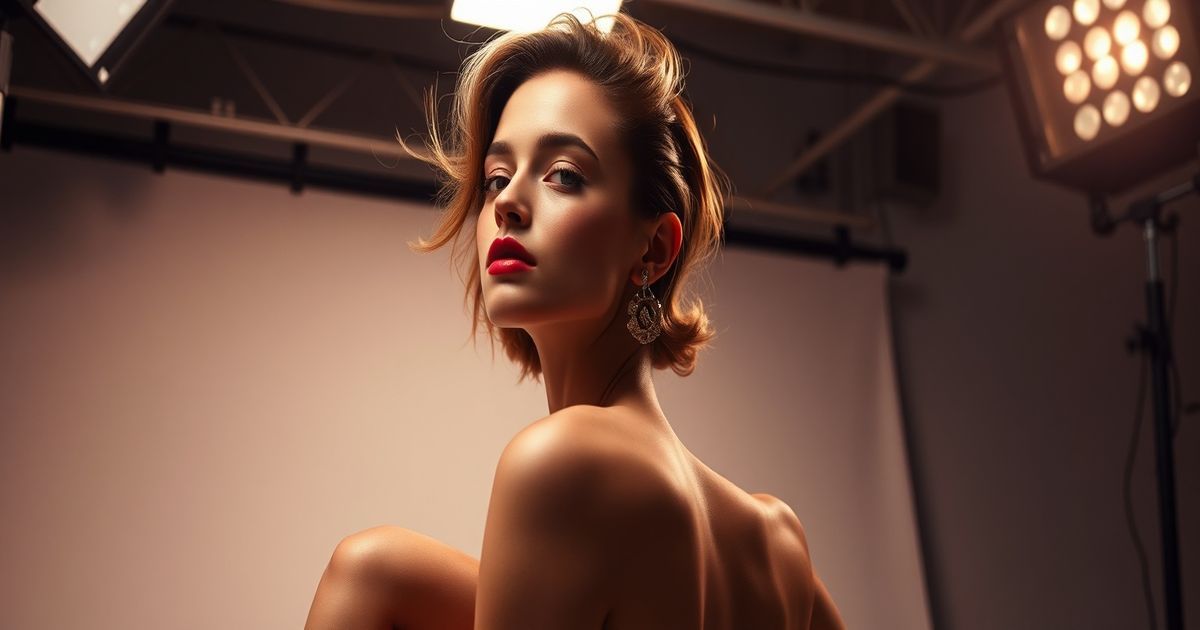
The difference between a good photograph and a remarkable one often comes down to posing. While natural beauty and strong lighting set the stage, it is the model's command of body positioning that transforms a frame into something unforgettable. Whether you are stepping into your first studio session or refining techniques honed over years, mastering the fundamentals of posing will elevate every image you create and strengthen your portfolio.
The S-Curve: Your Foundation
The S-curve is perhaps the most universally flattering pose in photography. By shifting your weight to one hip and allowing the opposite shoulder to drop slightly, your body creates a natural, flowing line that adds dimension and elegance to the frame. This gentle curvature avoids the stiffness of standing straight-on while producing a shape that draws the viewer's eye through the entire composition.
To achieve a natural S-curve, plant your weight firmly on your back foot. Let your front leg bend slightly at the knee. Allow your torso to follow the shift, creating a subtle arc from shoulder through hip. The key is making this position feel effortless. If you sense tension anywhere in your body, the camera will capture it.
Jaw Positioning and the Face
The most technically perfect body pose can be undermined by poor facial positioning. Your jawline is one of the most critical elements in portraiture and close-up work. Extending your chin slightly forward and down creates definition along the jaw, eliminating shadow beneath the chin and producing a more sculpted appearance on camera.
Avoid tilting your head too far back, which can create an unflattering perspective and cause your features to appear foreshortened. Instead, think of pressing your forehead gently toward the lens while keeping your chin at a natural angle. Practice this movement until it becomes second nature. Many experienced models describe the feeling as "pushing your ears back" rather than moving the chin forward, which prevents over-extension.
The camera does not see what the mirror sees. Learning to feel a pose rather than see it is what separates working models from beginners.
Hand Placement: The Overlooked Detail
Hands are one of the most challenging elements to pose naturally, and they are often the first thing that reveals inexperience. Stiff, flat hands or awkwardly clenched fists can distract from an otherwise compelling image. The general principle is simple: keep your hands relaxed and active.
- Soft contact. When placing hands on your body, use light fingertip pressure rather than a full grip. This creates elegance rather than tension.
- Show the edge. Presenting the side of your hand rather than the flat palm or back creates a more slender, graceful line in the frame.
- Give them purpose. Hands should always appear to be doing something, whether adjusting clothing, touching hair, or resting on a surface. Idle hands hanging at your sides rarely photograph well.
- Separate the fingers. Slightly separating your fingers prevents them from appearing as a single mass. A gentle, natural spread creates visual interest.
Weight Distribution and Grounding
How you distribute your weight determines the entire energy of a photograph. Placing equal weight on both feet creates a static, passport-photo quality. Shifting weight to one leg introduces dynamism and asymmetry, which the camera finds far more interesting.
For standing poses, commit fully to your weight-bearing leg. The non-weight-bearing leg can then be used creatively: crossed in front or behind, extended to the side, or bent at the knee. Each variation changes the silhouette and mood of the image dramatically. Experiment with these options during practice sessions to build a reliable repertoire.
Movement in Stillness
Some of the most captivating fashion photographs convey motion even though they capture a single frozen moment. Achieving this quality requires what experienced models call "movement in stillness," the art of arriving at a pose rather than holding one.
Rather than planting yourself in a position and waiting for the shutter, try continuously flowing between poses. Walk toward the camera and pause mid-stride. Turn your body and let the photographer capture the transition. Toss your head slightly and let your hair settle. These micro-movements create energy and spontaneity that static posing cannot replicate.
Editorial Versus Commercial Posing
Understanding the distinction between editorial and commercial posing is essential for versatility. Editorial work favors angular, dramatic, and sometimes unconventional positions. Shoulders can be exaggerated, expressions can be intense or abstract, and the overall mood often prioritizes artistic impact over approachability.
Commercial posing, by contrast, is warm, open, and inviting. Smiles are genuine, body language is relaxed, and the model should appear relatable. Shoulders face the camera more directly, and poses tend toward symmetry and stability. Knowing which register a shoot requires, and being able to shift between them seamlessly, marks a truly professional model.
Working Your Angles
Every face and body has angles that photograph more favorably than others, and discovering yours is an ongoing process. As a general starting point, turning your body roughly forty-five degrees from the camera is more flattering than facing it directly, as it narrows the frame and creates depth. For facial angles, most people have a preferred side. Spend time studying your test shots to identify which angle consistently produces the strongest results.
Practicing with Purpose
The mirror is your rehearsal studio. Spend regular time practicing poses, but do so with intention rather than vanity. Work through a sequence of positions, holding each for a few seconds before transitioning smoothly to the next. Record yourself on video to study your movements and identify habits that need correction.
Pay attention to how small adjustments, a shifted shoulder, a turned wrist, a degree of head tilt, change the overall impression of a pose. Over time, these micro-adjustments become instinctive, allowing you to respond fluidly to a photographer's direction without overthinking.
Common Mistakes to Avoid
Even experienced models occasionally fall into posing habits that weaken their images. Be mindful of these frequent errors.
- Locking joints. Locked knees and elbows create rigid, unnatural lines. Always maintain a slight bend.
- Hunching shoulders. Tension in the shoulders reads immediately on camera. Roll them back and down before each frame.
- Ignoring the lower body. Many models focus exclusively on facial expression and upper body positioning while neglecting foot placement and leg angles.
- Over-posing. Trying too hard can result in contorted, unnatural positions. When in doubt, simplify.
Mastering posing is a career-long pursuit. Each shoot presents new challenges, new clothing, new lighting, and new creative direction. The models who thrive are those who approach every session as both a performance and a learning opportunity, building a vocabulary of movement that grows richer with every frame. Explore our model resources for more tips on developing your craft.