Spring/Summer 2026 arrived on the runways as something of a watershed moment. With upward of fifteen creative directors making their debut at major fashion houses this season, SS26 did not merely update the wardrobe — it rewrote the visual language of contemporary fashion. For working models, understanding these shifts is not purely academic. The silhouettes walking the casting circuit, the color stories shaping editorial briefs, and the energy casting directors are asking you to embody are all rooted in what transpired on the runways of New York, London, Milan, and Paris. Here is what you need to know.
A New Creative Era Begins
The season's most immediate story was one of debuts. Jonathan Anderson stepped into Christian Dior, Matthieu Blazy took the helm at Chanel, and Dario Vitale made a seductive, color-saturated case for his vision at Versace. What unified these collections — and many others — was a shared sense of optimism and disruption. The shows were cinematic and bold, rejecting the quiet restraint that had defined much of the preceding decade. For models, this energy translates directly into casting briefs: clients and casting directors are looking for presence, physicality, and the ability to command a look that demands attention.
Sculpture Over Simplicity
If SS26 has a single overarching shape, it is sculptural. Designers leaned into dramatic proportions — exaggerated pannier-style hips, ballooning bell sleeves, and architectural peplums that looked more like structural objects than garments. At Alaïa, Balenciaga, and Christopher John Rogers, volume gathered around the hips in costume-like silhouettes evoking eighteenth-century dress. Gucci and Saint Laurent sent looks with sleeves so expansive they required deliberate, considered movement to carry well.
For models, this presents a specific technical challenge. Sculptural garments require a walk that is slower and more intentional than the athletic stride of recent seasons. The clothes need space to breathe and settle. Rushing through a turn or pivot can collapse a silhouette that a designer has spent months engineering. In fittings and callbacks for SS26 bookings, expect choreography notes that emphasize stillness, deliberate pace, and a heightened awareness of how the garment moves around your body.
The Return of Fringe and Movement
Alongside the structured and the architectural, there was a parallel trend in the opposite direction: garments designed for maximum movement. Fringe — long, tactile, and surprisingly refined — appeared across collections not as a bohemian reference but as a device for capturing light and motion. Chanel's hemlines swung as models walked; McQueen sent a train so voluminous it displaced the air around it. The message was that garments should have a life of their own, and the model's job is to collaborate with that life rather than dominate it.
"The model's role this season is to be a partner to the garment — not its carrier, but its collaborator. The best walks we saw understood that the clothes were doing half the work."
The Color Story: Chartreuse and Beyond
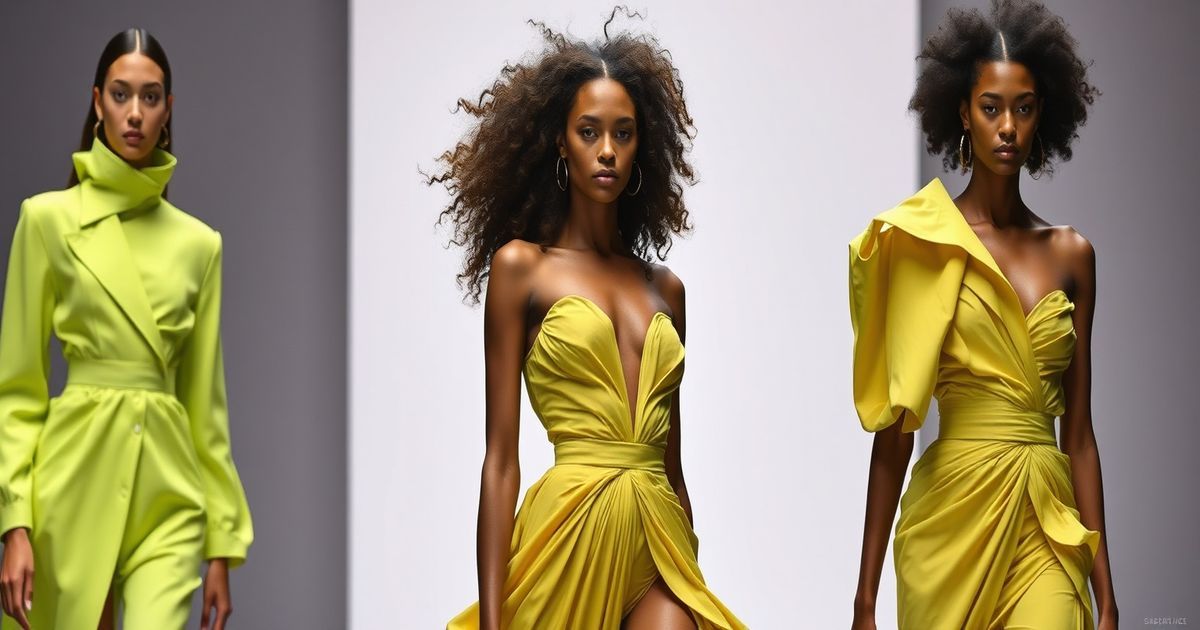
Every season produces a signature color, and SS26 belongs to chartreuse. The yellow-green shade emerged early in New York and then radiated outward through fashion month, appearing at Burberry, Erdem, Simone Rocha, Saint Laurent, Valentino, Balenciaga, and Alaïa. Its spread was remarkable not only for its breadth but for its versatility — worn as a monochrome statement, clashed against cobalt, or offset by warm neutrals.
Beyond chartreuse, the season pushed bold color clashing as a styling philosophy. At Prada, a poppy-red polo sweater met lavender hot pants. At Loewe, stacked poplin shirts in varying hues read as both playful and intentional. For models working editorial briefs this spring, comfort with bold color combinations will be essential — both in terms of the physical confidence required to wear them and the ability to project the right emotional register for each palette.
Monochrome as a Counter-Statement
Running parallel to the maximalist color stories was a strong thread of monochromatic dressing. Calvin Klein, under Veronica Leoni's direction, opened with a series of off-white looks that felt quietly commanding, the restraint itself a form of authority. Monochrome dressing this season carries a studied elegance — it asks the model to do the expressive work that pattern and color would otherwise perform. Clean lines and tonal precision make posture and movement even more visible, which rewards models with strong technique.
Casting Implications for the Spring Circuit
Understanding the dominant aesthetic of a season is directly useful for the casting process. SS26's emphasis on sculptural volume and deliberate movement means models who can demonstrate a measured, controlled walk — rather than a fast-paced commercial stride — will be better positioned for runway bookings. The editorial work emerging from this season rewards models who can hold stillness and allow the garment to fill the frame, particularly for the layered and oversized silhouettes that dominated in Paris.
Color confidence matters for editorial and e-commerce work. If your test shots are heavy on neutrals, consider adding images that demonstrate your ability to carry bold or unexpected color. Casting directors building SS26 editorial rosters are working from mood boards saturated with chartreuse, electric cobalt, and layered primary hues — your portfolio should show you belong in that world.
Finally, the spirit of this season is optimistic and slightly irreverent. The designers who set the tone — Anderson at Dior, Blazy at Chanel, Vitale at Versace — all brought a sense of joy and playfulness without sacrificing craft. That energy rewards models who can project warmth and confidence in equal measure. This is not a season for studied blankness. It is a season for presence.