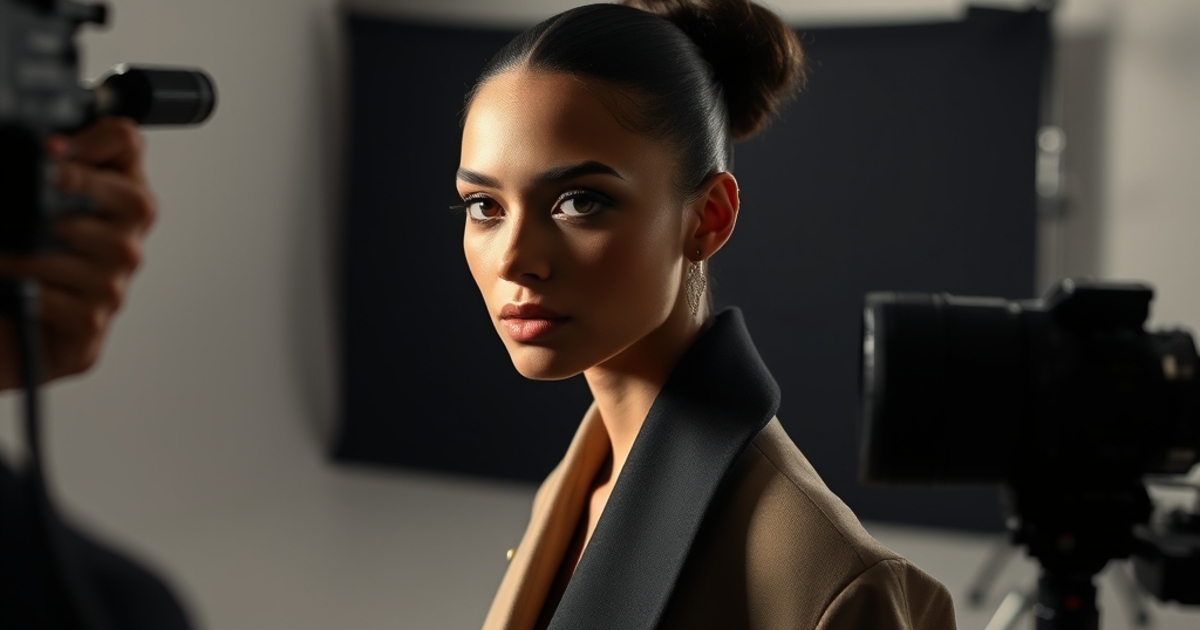
Something has shifted in the casting room. For generations, the checklist was familiar — height, measurements, a clean book, a neutral walk. Get the numbers right and the bookings would follow. That framework still exists, but it now accounts for only half the equation. In 2026, the casting directors who determine which faces define a season are asking a different question first: who is this person?
Across New York, Paris, Milan, and the markets that orbit them, a decisive turn toward personality-driven casting has reshaped how talent is evaluated, how agencies pitch their models, and how working models must present themselves at every touchpoint — from the initial go-see to the final callback.
The room remembers a personality. It forgets another perfect face by the end of the morning.
What Changed, and Why
The shift did not arrive overnight. It gathered momentum as fashion audiences grew more discerning and brand storytelling grew more demanding. Campaigns that once asked models to embody a mood board now require talent who can carry a narrative — someone whose cultural background, manner of movement, or singular way of inhabiting a garment adds meaning to the image rather than simply filling it.
Fashion audiences now retain personality-driven casting far longer than interchangeable runway lineups. A face that carries a distinct point of view becomes part of a brand's visual language. A face that is technically flawless but characterless disappears into the archive within weeks.
Major houses have quietly restructured their casting briefs accordingly. Where a brief once listed physical specifications almost exclusively, today's equivalent document often includes words like presence, cultural resonance, point of view, and energy alongside the measurements.
What Casting Directors Are Actually Watching For
Understanding the shift is one thing. Translating it into bookings requires knowing which specific qualities now carry weight in the room.
Cultural identity, worn with ease
Heritage is not a costume. Casting directors are acutely alert to talent who carry their cultural background naturally — models whose movement, carriage, or eye contact reflects where they come from in a way that feels lived-in rather than performed. That ease reads on camera. It reads even more clearly in a fitting room, where a model's relationship with their own body and aesthetic influences every image the creative team will work with for months.
Intentionality in stillness
The instinct to perform for a casting director can undermine a model faster than any measurement discrepancy. What the best casting directors are calibrating now is what a model does when they are not doing anything — whether stillness is blank or inhabited. A model who is genuinely present, even in a waiting room, projects something the camera can work with. One who switches on only for the photographer leaves behind a two-dimensional impression.
An opinion about the work
This is the quality most models underestimate. Casting directors and creative directors spend their careers in conversation with people who know exactly what they want from a shoot. When a model arrives with a perspective — on the garment, the brief, or the mood being built — it signals a collaborator, not just a body on set. The opinion does not need to be bold. It needs to be genuine. A thoughtful observation in a fitting is worth ten technically polished runway passes.
Consistency of character across formats
Modern campaigns span print, moving image, and live event formats, often simultaneously. Casting directors are now evaluating talent across the full breadth of those demands. A model who is electric on the runway but flat in a seated interview, or who photographs beautifully but loses authority in video, creates production risk. The talent being booked in 2026 tends to be characteristically coherent — the same person in every format, credibly themselves.
What This Means for How You Prepare
Personality-driven casting does not mean auditions have become therapy sessions. The shift is subtler and more practical than that. It is primarily about removing the filters that models habitually place between themselves and the room.
Go-sees that feel transactional — model walks in, book is reviewed, model walks out — are increasingly read as a warning sign. The casting directors who are shaping the current season want to meet someone, not review a product. That distinction sounds abstract but plays out in specific behaviors: making deliberate eye contact before the book is opened, answering questions with a complete thought rather than a deflection, and responding to a direction in the room with something other than compliance.
Preparation, in this context, means arriving with enough self-knowledge to be genuinely present. Know the house you are meeting. Know which images in your book matter to you and why. Know the difference between what you do well and what you are still developing — and be willing to say so. That level of self-awareness is not common in a casting room, which is precisely why it distinguishes the talent who gets called back.
Implications for Representation
For agencies, the implications of this shift are structural. Building a roster that answers personality-driven briefs requires knowing each model beyond their measurements — understanding their background, their aesthetic instincts, their natural energy, and which creative environments bring out the strongest work. The agencies consistently placing talent with discerning clients are the ones developing that depth of knowledge before casting season opens.
For models seeking representation, it means that how you present yourself to an agency matters as much as what you look like on arrival. The relationship between a model and their agent is built on mutual understanding. If a model can articulate who they are and what makes their approach distinctive, the agent can pitch them with specificity. Specificity books jobs.
The era of the interchangeable face has not ended — volume commercial work still rewards it. But at the level where careers are built and sustained, the casting room of 2026 rewards the model who is irreducibly themselves. That quality cannot be manufactured in the hour before a go-see. It is cultivated over time, through work, through self-reflection, and through the decision to show up as a person rather than a possibility.